
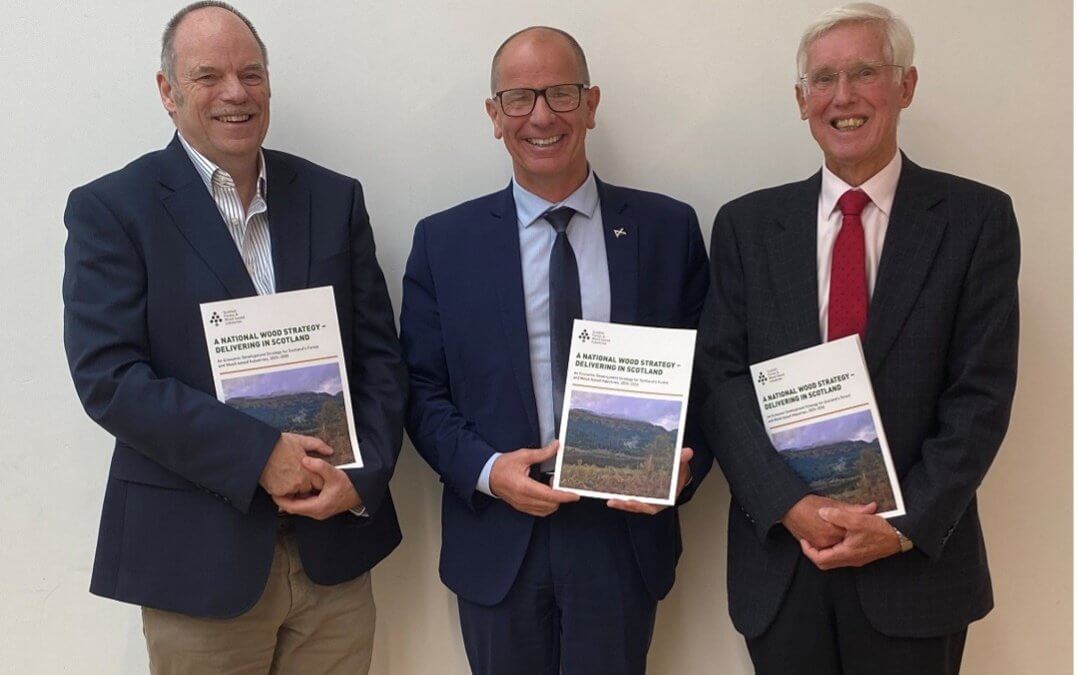
Scottish Minister for Agriculture, Marine and the Islands, Jim Fairlie, joined members of the Scottish Forest and Wood-based Industries Leadership Group at their recent meeting to launch their updated strategy for 2025 – 2035, called ‘A National Wood Strategy – Delivering for Scotland’.
This national strategy sets out the sector’s ambitions to increase its contributions to Scotland’s economic and climate change targets, working in partnership with the Scottish Government and its agencies.
Guy Watt, Chair of the Industry Leadership Group said: “The strategy covers all Scotland’s sources of wood fibre from Scotland’s forests, from imported wood fibre and from reusing and recycling wood fibre. It has been developed by representatives of companies in the private sector from across the wood-chain.”
Minister for Agriculture, Marine and the Islands Jim Fairlie said: “This document marks the next phase in driving forward the development of inclusive and sustainable growth in Scotland’s Forest and Wood-based Industries. I commend the sector for its progress and ambition and welcome this strategy as a platform for further growth, innovation and economic impact by 2035.”
The Leadership Group considers there are a wide range of exciting opportunities for the domestic forest industry to grow over the next 15 years as the forecast wood fibre availability in Scotland increases. These new opportunities are for increased processing and downstream manufacturing of and adding value to wood-based products in Scotland. As a result the contributions to the growth of the Scottish economy will also increase significantly particularly in the rural economy.
The Strategy also highlights the important contribution the sector makes to reaching climate change targets. This is because trees capture carbon from the atmosphere as they grow and store the carbon in their stems. This natural process makes a very important contribution to mitigating climate change in Scotland and globally. When sustainably managed trees are made into wood and wood products the captured carbon remains stored in these products throughout their lives.
Wood generally has low embodied energy compared to steel, brick or concrete that require much more energy to produce. This makes wood products a more sustainable choice of material for construction and manufacturing.
The Industry Leadership Group also recognises that trees, woods and forests are also an important part of Scotland’s ecosystem and biodiversity and can provide habitats for a range of Scotland’s unique flora and fauna. They also provide a range of recreational and tourist opportunities in both rural and urban areas.
The Leadership Group also notes a longer-term threat to the future of the sector in that by 2070 the availability of coniferous roundwood is forecast to fall well below forecast demand and current production. There is therefore a need to increase softwood availability by planting more coniferous woodlands, and increasing the productivity of our existing ones otherwise there will be job losses and Scotland will become increasingly dependent on imports.
You can view the updated strategy here.
Picture caption: (l-r) Andy Leitch, Executive at the Scottish Industries Leadership Group (and Deputy Chief Executive at Confor); Minister Jim Fairlie and Guy Watt, Chair of the Scottish Industries Leadership Group