The UK’s waste wood sector continued to process over four million tonnes of waste wood in 2025 despite challenging market conditions.
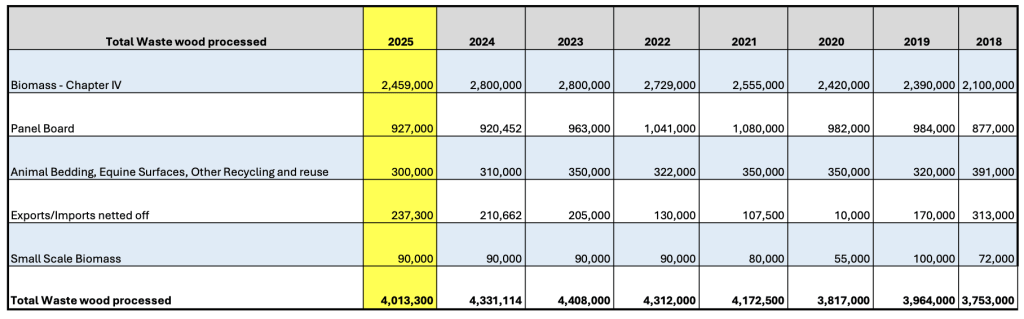
According to the latest annual statistics published today (June 25) by the Wood Recyclers’ Association (WRA), 4.013 million tonnes – or 89% of all waste wood generated in the UK – was sent for reuse, recycling or recovery last year. This represented a 7.3% fall in processing compared to 2024.
The decline comes after the market came under significant pressure last year, with a series of unplanned outages at end-use facilities creating oversupply and putting pressure on storage capacity.
While an 89% processing rate remains strong compared to other waste streams, the WRA said the decline highlighted the need for more flexible and risk-based regulation around waste wood storage to ensure as much waste wood is utilised as possible, with the best environmental outcome.
This is particularly important given that the sector is continuing to face higher waste wood volumes than usual, driven by seasonal factors and elevated stock levels carried over from last year.
The WRA warned that constrained storage during periods of disruption had led to material being diverted away from recycling and recovery into less desirable outlets, including landfill or unregulated outlets such as illegal dumping.
 Julia Turner, Executive Director of the WRA said: “These figures show that our sector proved resilient in 2025 in the face of very challenging and unprecedented market conditions. We continued to process over 4 million tonnes of material during the year which shows how our sector worked tirelessly to ensure material kept moving wherever possible.
“However, a small but significant proportion of waste wood was lost to outlets such as landfill or in some cases ended up at illegal waste sites. This underlines the urgent need for more flexible, risk-based regulation around storage to reflect the seasonal nature of our industry.
“Greater flexibility would allow responsible operators to safely store material during periods of disruption, ensuring more waste wood can ultimately be recycled or reused in the UK, rather than being lost from the circular economy.
“Without greater flexibility at permitted sites, there is a real risk that this summer, more material will find its way to illegal sites.”
She added: “We are continuing to work closely with regulators across the four nations to help the sector navigate current market pressures.”
Statistics
The 2025 data was produced by the WRA using the results of its annual survey of members who represent around 90% of the market by volume. These figures were then extrapolated and used alongside other industry data sets to produce total UK figures.
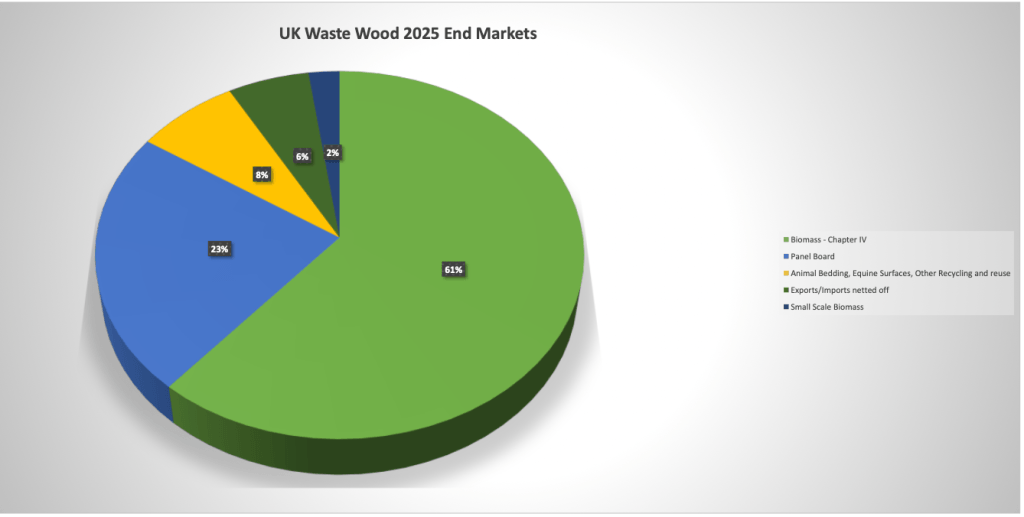
Looking at the figures in detail, other key takeaways include:
- The total amount sent to biomass was 2.459 million tonnes, representing a 12% decrease year-on-year
- The amount of waste wood used in panel board production increased slightly by 0.7% year-on-year to 927,000 tonnes
- Other recycling including animal bedding, equine surfaces and reuse fell slightly to 300,000 tonnes, while reuse increased by 12%
- Exports/imports netted off increased by just over 12% from 211,000 tonnes to 237,000 tonnes
- Use of wood in small scale biomass remained static at 90,000 tonnes
- Of the remaining material, the WRA believes that some was stored for processing in 2026, some sent to energy-from-waste facilities or landfill and some ended up to unregulated outlets such as illegal waste sites.
The WRA estimates that total UK waste wood arisings in 2025 remained constant at 4.5 million tonnes.
Commenting on the reuse figures, Julia said: “We were encouraged to see an uplift in reuse, driven by social enterprises sharing best practice and optimising their operations. We also know that even more wood than this is being reused, as these figures do not currently include reuse from household waste recycling centres which we would like to include in future.”